Proving Order Axioms for Dedekind Cuts
· First published on  Medium
This week, I started reading  Mathematical Analysis I by Zorich after it was recommended by a friend.
I wanted to prove one of the order axioms for Dedekind Cuts, which was left as an exercise to the reader. Who doesn’t love that phrase?
There are a couple of popular ways to construct real numbers. One is using  Cauchy Sequences, and the other is using Dedekind Cuts. While the former is also fascinating, let’s stick to the latter for now.
Informally, Dedekind cut is a an open interval towards the left over the number line. I’m being careful not to use the phrase “real number line”, as at this point, the reader doesn’t know what a real number is. We only know what rationals are. This is what a “cut” would look like:
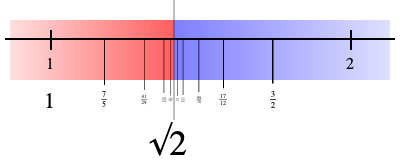
These are of interest, in my case, to prove the consistency of the  Axioms for the Real numbers. One way to prove consistency would be to show that there exists some non-empty set, which satisfies all the axioms. In this case we will show that this satisfies the Order Axiom.
Definition
A Dedekind cut is a partition of the rationals Q into two subsets A and B such that
- A is not empty.
- A is not Q (not all the rationals)
- Closed downwards: A contains all number less than every number in A.
- A does not contain a maximum.
There are a couple of properties that make this set interesting. It is bounded, but does not contain a maximum. It is implied from this definition that B is A complement. Mathematicians do not like to specify more things than absolutely needed.
We will use the following short hand to denote one “cut”. It is important for us convince ourselves that this is indeed a cut. It’s not the subject of this blog post so, i’ll leave it as an exercise to the reader.
In the above notation it is to be noted that “x” represents one cut, it does not uniquely identify a real. Dedekind Reals would be a set of all such “x”s. Below, we will refer to “x” as a Dedekind Real or real as a shorthand, and set of all Dedekind reals as “R”.
To be proved
This might seem obviously true on the first look, but remember we don’t even know how to compare reals yet. It’s also to be noted that, we are talking about comparing sets here, not numbers.
Let’s start by defining the order operation for reals:
Thankfully ZFC allows us to use subset notion. Talk about standing on shoulders of giants. Let’s now define x, y and z.
We know that x, y, and z are reals from our definition. Order axiom for rationals states that:
We need something that lets us map from Dedekind real space to rational space that lets us use the above axiom to prove order axiom for reals. Let’s prove the following lemma.
Lemma.
Proof. () If , every is itself in , so take . () Take any and pick with . If then . If , then because is closed downwards. Either way , which is .
Now, let’s look at the proposed order axiom for reals.
Let’s look at the right hand side of the axiom:
Take any . Since , the lemma gives with . Since , it gives with . By the order axiom for rationals, . So every element of is bounded by some element of , and by the lemma again, .
It is interesting to note that Cantor and Dedekind formulated the set theory in late 1800s. Zermelo (of ZFC) formulated the axioms even later in 1900s. This is long after calculus was invented. It’s very modern, but mathematicians were freely using real numbers long before then.
It was important to formulate these axioms to counter things like Russels paradox ( video).
If you are interested in history of mathematics, this article will be an interesting read.